
Blog Details
- Member
- March 4, 2026
The Insight Extraction Engine
Architecture for Rare Signal Discovery
Contextual Introduction
In an era of data saturation, standard statistical models often fail to identify "Rare Insights"—those high-leverage, non-obvious signals that are typically discarded as noise or outliers. Finding these signals requires a transition from descriptive analysis to a dynamic navigational approach. This model defines a rare insight as a discovery sitting on the edge of the feasible region, where a micro-variable possesses the highest mathematical leverage over a macro-outcome.
The Strategic Architecture of Rare Insight
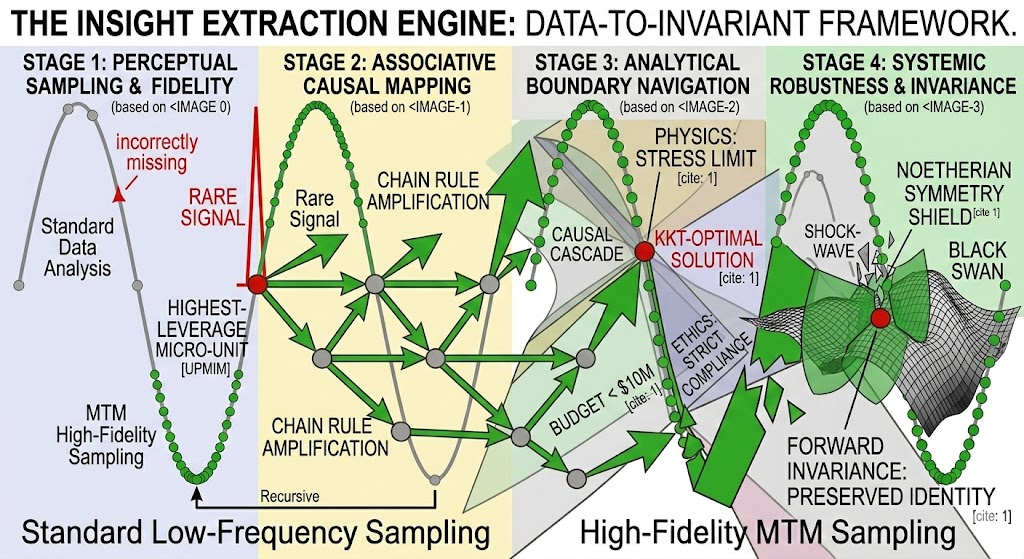
High-Fidelity Signal Acquisition Finding rare insights begins with the principle of high-fidelity sampling. Most models suffer from "aliasing" because they sample data at a frequency too low to capture the true complexity of a rare event. By matching the sampling frequency to the complexity frequency of the environment, the engine ensures that high-frequency anomalies are reconstructed as meaningful signals rather than being smoothed away as random fluctuations.
Derivative-Based Pathing and Sensitivity Once a signal is acquired, the engine applies sensitivity analysis to determine its potential impact. Rare insights are mathematically defined as "levers"; they represent micro-variables where the derivative of the desired outcome is exceptionally high. This stage identifies the specific micro-units with the highest leverage, allowing the user to ignore 99% of the data and focus on the 1% that will drive a radical shift in the system's trajectory.
Boundary Navigation and Constraint Optimization Rare insights often reside at the intersection of hard constraints that conventional logic deems "unsafe" or "impossible." Mathematical optimization provides the proof for the optimal path that exists precisely on the boundary of the feasible region. While standard analysis seeks the center of the "safe zone," the extraction engine seeks the "cliff edge"—the specific boundary conditions involving ethics, budget, or physics where a breakthrough solution satisfies all constraints simultaneously.
Systemic Benefits and Resilience
The primary benefit of this model is its robustness against "Black Swan" events. By utilizing minimax logic, the engine stress-tests the identified insight to ensure it minimizes the maximum possible loss, preventing over-optimization for a fluke occurrence. Furthermore, the model incorporates symmetry principles to ensure that the discovered insight preserves core invariants—the fundamental "soul" of the mission—even if the insight requires a radical pivot in strategy.
The Vectorization Process for Discovery
To extract rare insights from any dataset, follow this recursive protocol:
Calibrate Sensing: Increase the data sampling rate beyond the standard "mean" to capture sub-threshold fluctuations.
Map Sensitivity: Identify which of these fluctuations has the highest derivative relative to your target goal.
Define Boundaries: Map hard constraints to find the optimal path at the edge of the possible.
Update Probability: Shift the probability weight of your strategy toward the insight as micro-wins accumulate.
Verify Invariants: Ensure the breakthrough preserves the core identity and essential values of the project.